Selasa, November 29, 2016

Activitas in ubud

Ayung rafting apakah anda ingin mencoba? Wisatawan yang berjiwa petualang dan menyukai olahraga air jika liburan ke Bali, tentunya pernah mencoba kegiatan Bali rafting. Rafting adalah salah satu olahraga air atau Bali water sport dengan menaiki perahu karet dan mengarungi derasnya air sungai.
ayung rafting Kegiatan rafting di Bali dapat dilakukan di beberapa sungai. Di sungai Telaga Waja atau lebih terkenal dengan nama rafting Telaga Waja dan sungai Ayung di Desa Payangan Ubud Bali, seperti yang anda tahu Ubud adalah salah satu objek wisata di Bali. Untuk menuju ke tempat ini menempuh waktu 1 jam dari Bandara Ngurah Rai Bali, melewati obyek wisata Kuta, objek wisata Sanur dan kota Denpasar.

Ayung Rafting Ubud Bali

Setelah sampai di tempat starting point, rafting di sungai Ayung akan segera dimulai. Para peserta akan diberi pengarahan oleh instruktur yang sudah terlatih dan berpengalaman dengan Ayung river rafting. Misalnya pengenalan alat-alat yang digunakan seperti jaket pelampung, dayung, perahu karet, posisi duduk di atas perahu, cara penyelamatkan diri jika perahu terbalik, dan hal- hal lainnya yang berkaitan dengan kenyamanan dan keselamatan peserta .
Masing-masing boat menampung 4 orang peserta ditambah 1 orang instruktur. Selama kurang lebih 2 jam anda akan mencoba mengarungi derasnya sungai Ayung yang menempuh jarak kurang lebih 12 km. Dalam perjalanan peserta dapat menikmati jeram-jeram sungai Ayung dan berfoto-foto di batu batu pinggir sungai yang latar belakangnya ukir-ukiran sepanjang ratusan meter. Hal ini mencerminkan kreatifitas seni yang tinggi dari orang Bali sehingga menjadi ciri khas dari obyek wisata rafting di sungai Ayung.
arung jeram sungai ayung
Bagi anak-anak yang ingin mencoba Ayung Rafting, tidak perlu khawatir karena airnya tidak terlalu deras dan jeramnya tidak menukik. Namun harus tetap ditemani orang tua masing-masing. Olahraga ini sangat seru dan menantang. Apalagi dilakukan beramai ramai bersama keluarga dan teman. Lihat disini, klasifikasi tingkat kesulitan sungai di Bali untuk rafting.
Setelah mengarungi air sungai Ayung sepanjang 12 km, peserta akan sampai di stopping point. Di tempat ini disediakan tempat beristirahat, ruang ganti, kamar mandi, dan handuk gratis. Kegiatan akan dilanjutkan dengan menikmati makan siang dengan menu buffet yang telah disediakan. Obyek wisata Ayung Rafting ramai dikunjungi wisatawan dari dalam negeri maupun mancanegara. Terutama menjelang Natal, Tahun Baru, liburan sekolah dan hari libur nasional lainnya. Baca lebih lengkap tentang informasi tempat wisata di Ubud Bali.
Kami sebagai agent penyedia layanan water sport di Bali, menyediakan Bali rafting untuk anda, tentunya dengan harga yang jauh lebih murah dari pada anda datang langsung ke tempat permainan. Kami hanya merekomendasi 3 perusahaan peyedia Ayung rafting, ketiga perusahaan tersebut anda dapat lihat di tabel di bawah. Ketiga perusahaan menawarkan harga yang berbeda-beda, mulai yang termurah sampai yang termahal. Semua perusahaan yang kami rekomendasi, memiliki rekor keselamatan 100%.

Selasa, Juni 14, 2016

View Rice Terrace

Tanah Lot Temple

  • Tanah Lot Temple is one of Bali’s most important landmarks, famed for its unique offshore setting and sunset backdrops. An ancient Hindu shrine perched on top of an outcrop amidst constantly crashing waves; Tanah Lot Temple is simply among Bali’s not-to-be-missed icons.
    The onshore site is dotted with smaller shrines alongside visitors’ leisure facilities that comprise restaurants, shops and a cultural park presenting regular dance performances. The temple is located in the Beraban village of the Tabanan regency, an approximate 20km northwest of Kuta, and is included on most tours to Bali’s western and central regions.
  • Legend of Tanah Lot

    Dang Hyang Nirartha, a high priest from the Majapahit Kingdom in East Java who travelled to Bali in 1489 to spread Hinduism, arrived at the beautiful area and established a site honouring the sea god, Baruna. Here, he shared his teachings to Beraban villagers, only to face opposition from the village chief who soon gathered his loyal followers to dispel Nirartha. The priest resisted, incredibly shifting a large rock he meditated upon out to sea while transforming his sashes into sea snakes to guard at its base. The rock’s original name, Tengah Lod, means ‘in the sea’.
    Acknowledging Nirartha’s powers, the humbled chief vowed allegiance. Before setting off, Nirartha gifted him a holy kris dagger, which is now among the sanctified heirlooms of the Kediri royal palace. Pilgrims bring these relics each Kuningan day by foot on an 11km pilgrimage to the Luhur Pakendungan temple, the priest’s former meditational site.

    Tanah Lot Highlights and Features

    After centuries of large waves persistently crashing at its rock base, Tanah Lot faced the constant threat of erosion, reaching a significant decline in 1980. The authorities carried out preservation efforts to Tanah Lot and other historical sites island-wide with aid from the Japanese government. Fully restored, a third of the present Tanah Lot is actually artificial rock.
    At high tide, waves flood the causeways making it impossible to cross. At low tide, you may cross to view the rock base where the legendary ‘guardian’ sea snakes dwell in crevices around the Tirta Pabersihan fountain. This natural spout is the source of holy water for all the temples in the area. Priests at the fountain bless visitors by sprinkling holy water over their heads. You can cup your palms and take a sip to prove it is amazingly fresh water.
    Onshore temples include the Penyawang, a spiritual proxy to Tanah Lot that hosts pilgrims when the main offshore temple is inaccessible during high tide. Other smaller temples around the site host prayer sessions for various aspects of the villagers’ agrarian life, from good rice harvests to rites of passage. North of Tanah Lot is Batu Bolong, similarly built on a rock formation with a ‘hollow’ overpass linking to the mainland.
    Convenient pathways and well-kept tropical gardens line the grounds from Tanah Lot to Batu Bolong, with resting spots offering shades and good viewpoints to both outcrops. Art shops selling souvenirs and curios of all sorts line the pathway from the parking area to the temple, also with peddlers selling traditional snacks such as jaja kelepon –yummy, must-try palm sugar-filled gelatinous balls rolled in grated coconut.

Senin, Juni 13, 2016

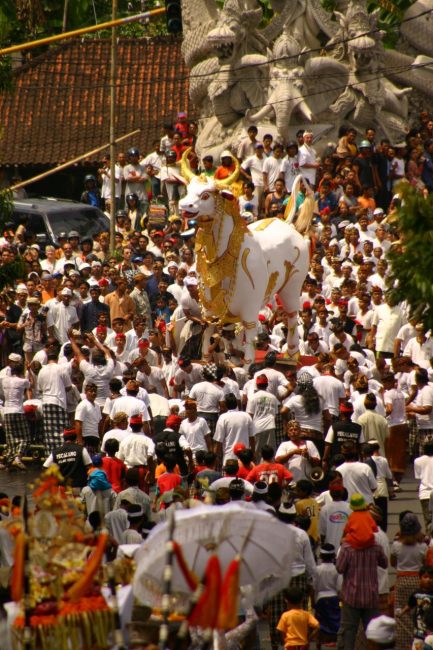
cremation ceremony

 
Ngaben, or Cremation Ceremony, is a funeral ritual performed in Bali to send the deceased to the next life. The body of the deceased will be placed as if sleeping, and the family will continue to treat the deceased as sleeping. No tears are shed, because the deceased is only temporarily absent and will reincarnate or find final rest in Moksha (freeing from the reincarnation and death cycle).
The proper day of the ceremony is always a matter of consulting a specialist on ceremony days. On the day of the ceremony, the body of the deceased is placed inside a coffin. This coffin is placed inside a sarcophagus resembling a buffalo (Lembu) or in a temple structure (Wadah) made of papier-maché and wood. This sarcophagus is then borne to the cremation site in a procession, which is almost never walked in a straight line. This is done to confuse evil spirits and keep them away from the deceased.
The climax of a Ngaben is the burning of the sarcophagus containing the body of the deceased. The fire is viewed as necessary to free the spirit from the body and enable reincarnation.
Ngaben is not always immediately performed. For members of the elite castes, it is normal to perform the ritual individually for the deceased within three days. People of lower social classes opt for a more economic solution where they first bury the deceased, who is then cremated with the village's other dead in a mass ceremony.